High & Low Return Vents: Summer vs. Winter | Lehigh Valley
Homes Should Come With Manuals—HVAC Part 1
Many older homes throughout Allentown, Bethlehem, Easton and the greater Lehigh Valley contain HVAC features that were installed without instructions being left for the homeowner. Paired high and low return-air vents are a common example.
These adjustable returns may help improve seasonal air circulation when they are used as originally designed. During cooling season, the upper return is generally opened to collect warmer air near the ceiling. During heating season, the lower return is opened to draw cooler air from floor level back to the furnace.
This guidance applies only to paired high and low returns designed for seasonal operation. It does not mean homeowners should close ordinary return vents throughout the house.
Also keep in mind during renovations the grill covers or registers may have been replaced and now are not adjustable.
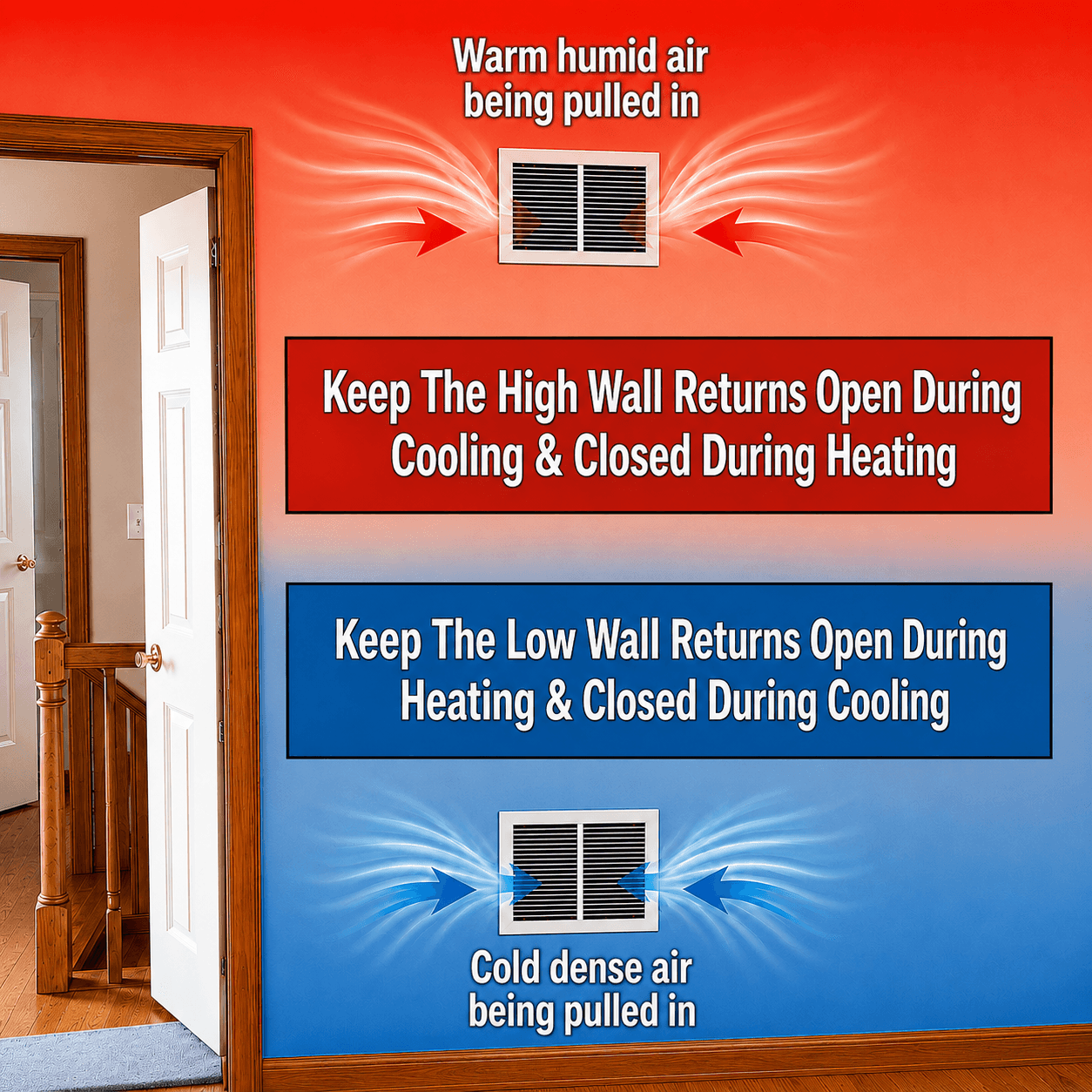
Quick Seasonal Return-Vent Guide
• Summer: Open the high return and close its paired low return.
• Winter: Close the high return and open its paired low return.
Why Return-Air Location Matters
Return vents do not blow heated or cooled air into the room. They pull room air back toward the furnace or air handler so it can be filtered and reconditioned. The location of that return path can influence how effectively air circulates through the occupied space.
Air temperature affects density. Warmer air is less dense and tends to collect higher in a room, while cooler, denser air tends to settle lower. A correctly designed pair of high and low returns allows the homeowner to select the return location that best supports the current season.
Summer Setting: Open the High Return
During air-conditioning season, open the upper return and close its paired lower return.
The high return helps collect warmer air that has accumulated near the ceiling and sends it back to the air conditioner for cooling and dehumidification. Closing the paired low return can reduce the chance that recently cooled air near the floor takes a short path back into the system before circulating through the room.
This adjustment can be particularly useful in two-story Lehigh Valley homes where upper floors become uncomfortable during humid Pennsylvania summers. However, a return adjustment cannot compensate for attic heat gain, duct leakage, inadequate insulation or poor system balancing.
Winter Setting: Open the Low Return
During heating season, close the upper return and open its paired lower return.
The lower return draws cooler air from floor level back to the furnace or air handler for reheating. Closing the paired upper return reduces the chance that rising warm air will be collected near the ceiling before it has circulated through the occupied portion of the room.
If rooms still feel cold at floor level after the returns are correctly adjusted, the home may have other problems such as uncontrolled air leakage, missing insulation, weak supply airflow or pressure imbalances.
Do Not Close Singular Return Vents
The seasonal adjustment described here applies only to paired return grilles designed to share the return-air path. Do not begin closing standard return vents throughout the home.
Your HVAC system depends on adequate return airflow. Furniture, rugs, draperies, dirty filters and improperly closed grilles can all restrict that airflow. ENERGY STAR notes that many residential systems already have return ducts that are too small and recommends evaluating the balance between supply and return airflow.
Insufficient airflow may contribute to:
• Uneven temperatures and reduced comfort
• Longer equipment run times and increased energy use
• Excessive airflow noise
• Furnace overheating or high-limit cycling
• Air-conditioning evaporator-coil freezing
• Additional stress on the blower and other components
Carrier also identifies blocked airflow as a condition that can contribute to frozen air-conditioning coils. Supporting sources: ENERGY STAR, A Guide to Energy-Efficient Heating and Cooling; Carrier, Will a Frozen AC Fix Itself?
Confirm the Vents Are Actually Paired
Not every high or low wall grille is intended to be closed. Before making an adjustment, confirm that the two grilles connect to the same return path (wall joist cavity) and adjustable louvers still exist that are designed for this seasonal operation.
If their purpose is uncertain, leave them open until the duct configuration and system airflow can be evaluated. A qualified home-performance or HVAC professional can determine whether closing either grille will preserve the return-air capacity required by the equipment.
When a Simple Adjustment Is Not Enough
Seasonal return adjustment may improve circulation, but it cannot correct undersized ductwork, disconnected returns, excessive duct leakage or defects within the building envelope.
Project Probono uses measured airflow, pressure and duct-leakage diagnostics to identify the actual causes of uneven temperatures and HVAC performance problems. When inaccessible duct leakage is confirmed, Aeroseal duct sealing may be one component of a complete corrective plan.
If your rooms remain difficult to heat or cool after the returns have been correctly adjusted, the next step should be diagnostic testing—not automatically replacing or enlarging the HVAC equipment.
Frequently Asked Questions
Which return vent should be open during summer?
When paired high and low returns are specifically designed for seasonal adjustment, the high return is generally opened during cooling season and its paired low return is closed.
Which return vent should be open during winter?
During heating season, the lower return is generally opened and its paired upper return is closed.
Should I close return vents throughout my house?
No. Do not close ordinary return-air vents. Restricting the system’s total return airflow can reduce performance and may contribute to equipment problems.
Why is my second floor still too hot?
Persistent temperature differences may result from duct leakage, inadequate supply or return airflow, attic air leakage, insufficient insulation, solar heat gain or improper system balancing. Seasonal return adjustment may help circulation, but it will not correct those underlying conditions.
Your Home Should Have Come With a Manual
Pennsylvania homes experience demanding heating and cooling seasons. Understanding small features such as paired return-air vents can help homeowners operate their systems more comfortably, efficiently and safely.
Project Probono has provided residential building-performance diagnostics and corrective retrofit installations throughout the Lehigh Valley since 1997. Our BPI-certified team performs both the testing and recommended installations in-house, without subcontractors.
Begin your home-performance audit request.
About me: Michael John Ohm has worked in residential building performance, energy diagnostics and corrective retrofit installations throughout the Lehigh Valley since 1997. He leads Project Probono LLC, a BPI-certified home-performance contractor serving Allentown, Bethlehem, Easton and surrounding Eastern Pennsylvania communities.